
Backbone Youth Release Privacy
Backbone Mountain Youth Center serves male youth in a secure treatment setting. Juvenile information follows a different legal and operational path from adult booking and correctional records. A youth’s presence, movement, approved release, aftercare plan, or transfer should not be inferred from an adult Sheriff log, an adult state prison locator, an adult court-summary method, or a booking-photo source. Those systems were not designed to confirm a juvenile placement.
An authorized family member should use the contact plan already provided by DJS. Counsel can work through the juvenile case and court. A case manager can explain the release or aftercare process to people entitled to receive that information. Public callers should expect staff to protect identity and case details. Lack of public confirmation does not mean the youth is missing, released, or still at the center.
Backbone Youth Release Contacts
The official DJS facility page identifies the center and supplies the public address and telephone. Callers should state whether they need general facility information, directions, or authorized case routing. Staff can explain what proof of identity or authorization is required before discussing any youth-specific matter.
Maryland Department of Juvenile Services
124 Camp 4 Road
Swanton, MD 21561
301-359-9190
The official source does not publish a public release desk, release counter hours, or a public family waiting location. Call before travel. An authorized pickup should be arranged through the case team, not improvised at the gate. The center’s main line is also the proper place to ask where general correspondence or official records questions should be directed.
The DJS source page and following image establish the facility identity and contact route.
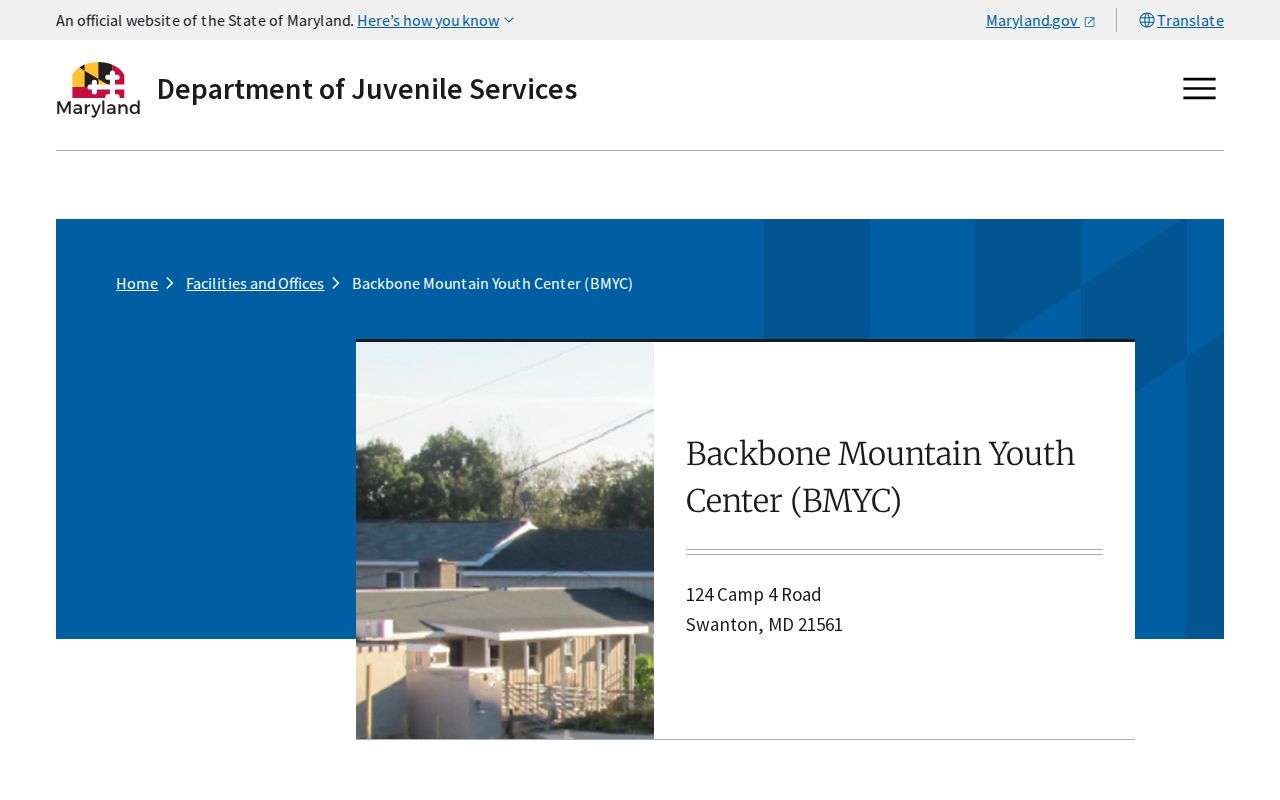
The image reinforces the essential boundary: DJS, not an adult county jail system, operates Backbone Mountain Youth Center.
Backbone Youth Release Program
DJS describes Backbone Mountain Youth Center as a secure treatment program for male youth, with a typical program length of six to nine months and a population of up to 24 on the facility page. A separate FY 2025 DJS data guide reported a capacity of 28. These figures come from different sources and measures. They must remain labeled rather than merged into one unexplained number.
A typical program duration is not an individual release date. Court action, treatment progress, placement decisions, and case-specific requirements can affect the actual path. No one should count forward from the general six-to-nine-month description and present the result as a promised release day. The case manager and juvenile court record are the only sound route for an authorized person seeking a specific timeline.
Backbone Youth Release Records
A release or aftercare record may contain protected juvenile information. The right to see it depends on the requester’s role, the record type, and applicable law or court rules. An authorized person should identify the exact document, the youth’s case, and the relationship or authority that permits access. DJS or the juvenile court can explain identity and consent requirements.
Do not send a juvenile request to the Garrett County Sheriff merely because the center is located in Garrett County. The Sheriff does not operate Backbone Mountain Youth Center. The Maryland Department of Juvenile Services is the facility operator, and the juvenile court controls its own records. A focused request to the correct custodian reduces delay and prevents protected facts from being sent through the wrong channel.
| Need | Authorized route | Boundary |
|---|---|---|
| Release or aftercare plan | DJS case manager | Shared only as law and authorization allow |
| Juvenile court order | Counsel or juvenile court | Not an adult public case-search task |
| Facility logistics | Backbone Mountain Youth Center | General line may require identity verification |
| Program description | Official DJS facility page | Does not confirm an individual youth |
Note: A public-record request cannot be used to bypass juvenile confidentiality or a court restriction.
Backbone Youth Release Aftercare
Leaving a secure treatment building can lead to aftercare, another placement, a return home under an approved plan, or another court-directed outcome. “Released” does not always mean all DJS involvement has ended. The case team should explain who will supervise the next phase, what appointments are required, and which person may receive schedule details.
Authorized families should confirm medication continuity, education records, transportation, identification, property, and the name of the next case contact. The research does not publish a Backbone-specific checklist, release time, pickup point, or aftercare schedule. Those facts must come from the individual plan. Ask direct questions early enough for staff to resolve documents and transportation without disclosing the youth’s information to an unauthorized person.
- Secure treatment
- A placement where movement is controlled while services are provided.
- Aftercare
- Support and supervision following a secure placement.
- Case manager
- The assigned professional who coordinates the youth’s plan and authorized communication.
- Placement
- The court- and agency-approved setting where a youth lives and receives services.
Backbone Youth Release Boundaries
The Garrett County Sheriff Arrest Log concerns adult county arrest activity and must not be used to find a Backbone youth. The Maryland DPSCS incarcerated-individual tool concerns covered adult correctional custody and is also inappropriate. Adult VINE, BOP, ICE, public mugshot, and adult case-search procedures are not substitutes for DJS communication. Even if a name appears elsewhere, it cannot be assumed to identify the youth or the same event.
This exclusion is substantive, not just technical. Juvenile proceedings and records receive protections that adult systems do not. Public adult sources may expose dates or images that should never be joined to a youth’s identity. The safe rule is simple: if the inquiry concerns Backbone Mountain Youth Center, stop using adult public sources and return to DJS, counsel, the case manager, or the juvenile court.
Backbone Center Garrett Context
Backbone Mountain Youth Center is located in Swanton, but it is not a Garrett County Sheriff facility. Its location does not place it under the county adult detention process. This distinction also means that the Sheriff’s local ICE history and the county jail’s 1978 facility history do not describe the youth center. The proper source is the Maryland DJS facility directory.
No official material reviewed identified a public youth release feed, an adult-style booking archive, or a public name locator for Backbone Mountain Youth Center. That is not a research failure to be filled with guesses. It is a privacy boundary. General facts such as the address, phone, operator, program population, and typical program length can be stated. Individual release and placement facts must stay within the authorized case path.
Public Record Search
Sponsored Results