
Maryland DOC Release Scope
The Maryland Department of Public Safety and Correctional Services, Division of Correction, operates the state prison system. A Garrett County court can commit a sentenced person to the Commissioner of Correction, but Garrett County is not a dependable facility filter. DPSCS may place the person in a suitable institution elsewhere in Maryland and may later move that person. Nearby Western Correctional Institution and North Branch Correctional Institution are in Allegany County, not Garrett County, and must not be listed as local Garrett facilities.
State release also has several meanings. Parole is conditional release approved by the Maryland Parole Commission. Mandatory supervision is a conditional release based on the sentence less allowed diminution credits. A person can also reach maximum expiration, receive a court-ordered release, or transfer to another custodian. The official record must identify the event. A Garrett County Sheriff status cannot establish release from a state prison.
Maryland DOC Custody Locator
Maryland calls its public tool the Incarcerated Individual Locator. Its purpose is current placement, not released-person history. It covers some people committed to the Commissioner and held at Division of Correction facilities, Patuxent Institution, and certain short-sentenced people at Division of Pretrial and Detention Services facilities. DPSCS warns that not every person in its custody appears.
The decisive limitation is explicit: people no longer in custody for any reason, including release or escape, are not listed. A positive result can support current placement at the time checked. No result cannot prove lawful release. The person may be outside the tool’s covered population, transferred, released, escaped, misspelled, or affected by a data delay.
- Enter the first and last name in the official DPSCS locator.
- Try supported legal-name variants only when another record justifies them.
- Compare any placement result with a date of birth, case, or other reliable identifier.
- Record when the current-custody result was checked.
- If no match appears, move to VINE, the court, supervision, and DPSCS records.
The official DPSCS locator image documents the current-custody boundary that governs this search.
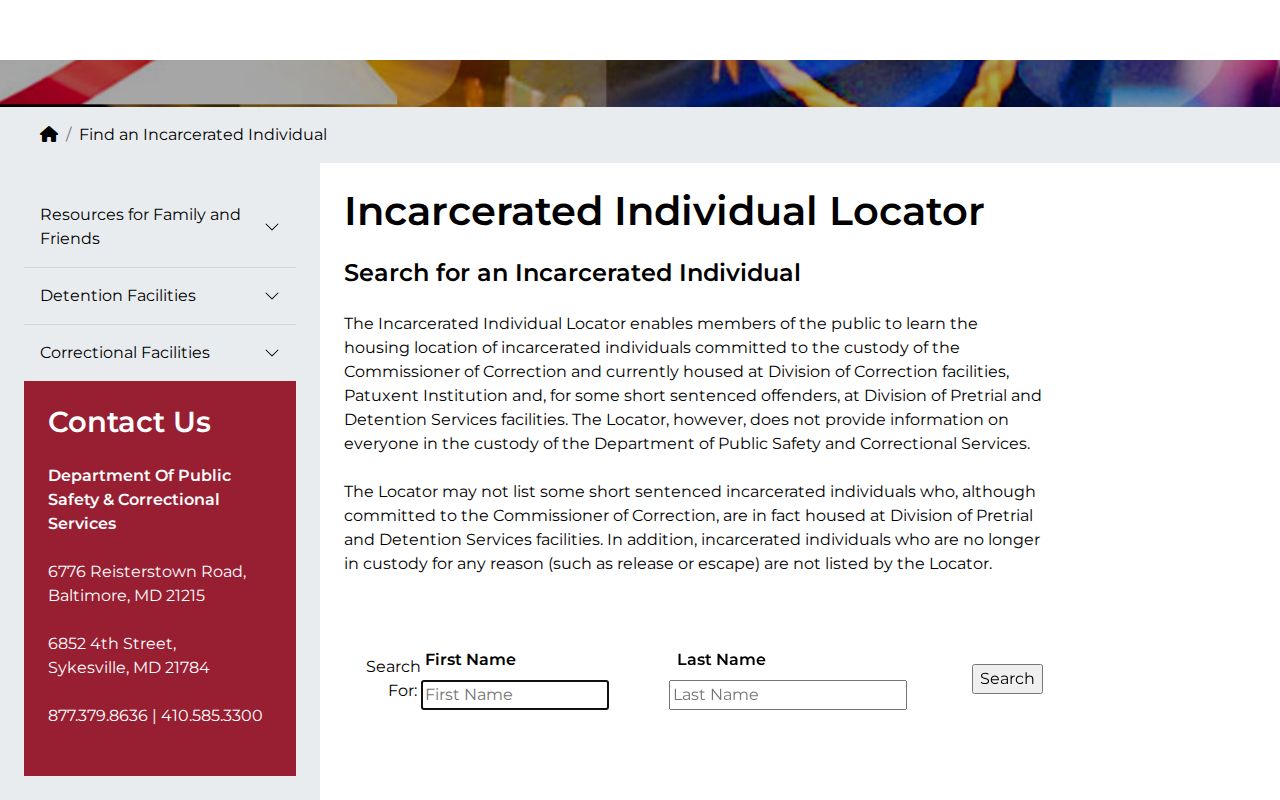
The image confirms why a former state prisoner requires VINE, court, supervision, or DPSCS records after disappearing from locator results.
The broader Garrett County release search helps distinguish a county jail exit from a state discharge. Do not keep searching the county log once the record shows commitment to the Commissioner.
Confirm Maryland DOC Discharge
A released state prisoner disappears from the public DPSCS locator, so confirmation requires sources that retain events or legal context. Maryland VINE can cover Division of Correction, courts, parole, and probation. Open a matching record only after comparing identifiers and reporting agency. A VINE custody release, a court event, and a parole status change are different events even when they concern the same person.
Search the Garrett sentencing case in Maryland Judiciary Case Search. The docket may show sentence changes, commitment, later orders, or a disposition that affects custody, but it is not the institution’s time-computation ledger. Contact the Division of Parole and Probation when parole, mandatory release, or supervised status may apply. Maryland does not provide a public person-name parole or probation lookup, and staff may restrict disclosure.
| Channel | Best evidence | Limit |
|---|---|---|
| DPSCS locator | Covered current placement | No released history or projected date field |
| Maryland VINE | Reported custody or supervision event | Exact label and retention can vary |
| Sentencing docket | Judicial sentence and later orders | Not the certified credit ledger |
| DPSCS record | Actual release type, dates, and computation | Access and redaction rules apply |
Note: Locator absence is weak evidence and must never be restated as a confirmed Maryland DOC release.
Maryland DOC Release Records
A focused DPSCS request should identify the person, DOC identifier if known, Garrett sentencing case, and the exact records sought. Useful terms include actual release date and type, release certificate, maximum expiration date, projected mandatory-supervision date, diminution-credit ledger, recalculation history, and publicly disclosable supervision status. A third party may receive less than the individual or an authorized representative.
DPSCS general contact is 6776 Reisterstown Road, Baltimore, MD 21215, with 410-585-3300 and 877-379-8636. Data Processing lists 410-585-3350, 3351, and 3352 for current-custody inquiries and asks callers to have name, date of birth, race, sex, and other identifiers. That telephone route is not a guaranteed release-history service. Ask staff to identify the proper PIA or records custodian.
6776 Reisterstown Road
Baltimore, MD 21215
410-585-3300
877-379-8636
Data Processing: 410-585-3350 / 3351 / 3352
Maryland DOC Release Types
The release type tells a reader what legal control remains. Parole continues the sentence in the community under conditions. Mandatory supervision also remains conditional until the sentence’s maximum expiration unless lawfully discharged sooner. Maximum expiration generally ends the correctional term. A court order can change the sentence or custody basis. A transfer ends custody at one institution but does not itself release the person.
- Parole
- Conditional community release authorized by the Maryland Parole Commission.
- Mandatory supervision
- Conditional release when the term less allowed credits reaches the statutory point.
- Discharge
- The official end of the relevant correctional custody or supervision.
- Transfer
- Movement to another institution or legal custodian rather than return to the community.
Maryland Correctional Services § 7-301 governs parole eligibility, but eligibility is not release. The Commission can refuse parole, set a rehearing, or approve release with prerequisites. A hearing calendar proves only that an open hearing was scheduled. It is not an individual decision database or a promise of same-day discharge.
Maryland DOC Release Dates
The public locator does not advertise a projected, tentative, parole, maximum-expiration, or past release-date field. An official date may exist in an institutional time computation, authorized case information, a VINE event when supplied, or records produced by DPSCS. Ask for the agency’s own label and identify the date on which the projection was current.
Credits, jail time already served, concurrent and consecutive terms, credit forfeiture or restoration, court modifications, parole action, violation action, escape or noncustody time, and other jurisdictional holds can change the calculation. Maryland Correctional Services §§ 3-704 through 3-708 set parts of the state diminution-credit framework and aggregate limits. These rules cannot be turned into a reliable web calculator without the official ledger.
No general Maryland rule requires every prisoner to serve about 85 percent. That federal shorthand must not be imported into a Maryland state sentence. Parole eligibility and mandatory-supervision timing depend on the offense, sentence, dates, credits, and statutes that actually apply.
Maryland DOC Community Supervision
The Division of Parole and Probation supervises qualifying people after parole, mandatory release, and probation events. Garrett County has a local state office: Oakland Field Office/DDMP at 221 A South Third Street, Oakland, MD 21550, 301-334-8113. Its presence does not prove that every person sentenced in Garrett returns to Garrett for supervision. The approved plan and assignment control.
There is no public Maryland name-based supervision lookup. An inquiry should ask whether the office can confirm a routing fact or identify the proper records process. The Maryland Parole Commission lists 410-585-3200 and 877-241-5428 for commission matters. Those decision and supervision agencies serve different roles and should not be treated as one source.
Maryland DOC ICE Transfers
A person leaving Maryland DOC custody may face a hold or transfer to another sovereign. Garrett County’s former ICE 287(g) arrangement ended in February 2026, but that county policy does not determine whether a state prisoner has an immigration matter. If the release record names ICE, use the ICE Online Detainee Locator and the Baltimore Field Office route.
A state locator no-result and an ICE no-result together still may not prove community release because each system has scope and timing limits. Follow the receiving-agency entry, court record, and official release certificate. A detainer is a request or notice affecting custody; it is not itself a completed transfer.
Note: State discharge, parole, and handoff custody are different events even when they occur on the same date.
Maryland DOC Garrett Placement History
The Sheriff’s current Garrett County jail dates to 1978, but that local history does not describe the Maryland Division of Correction estate. A person can begin at Garrett County Detention Center and later be committed statewide. The Sheriff log may show SENTENCED without naming the current state facility. Obtain the commitment and follow DPSCS placement instead of assuming the person stays near Oakland.
No Maryland state prison appears at a Garrett County address in the reviewed official directory. This absence is an important local fact. It prevents neighboring Allegany County institutions from being mislabeled as Garrett facilities and keeps the release path accurate: statewide DOC locator while held, then VINE, supervision, the sentencing case, and DPSCS records after release.
Public Record Search
Sponsored Results