
Garrett Parole and Probation
Parole and probation can look alike because both let a person live outside a secure facility under stated rules. Their legal sources differ. The Maryland Parole Commission decides parole matters for eligible Maryland sentences. The Division of Parole and Probation, part of the Department of Public Safety and Correctional Services, supervises parole, mandatory supervision, and probation cases within its authority.
Probation comes from the sentencing court. It may follow time in custody, accompany a suspended part of a sentence, or begin without a prison commitment. Garrett County Pre-Trial Services and Home Detention are separate local programs. They may supervise a person who is physically out of the jail, but they are not state parole or probation.
| Record point | Parole | Probation |
|---|---|---|
| Authority | Maryland Parole Commission | Sentencing court |
| When it starts | Conditional release during a sentence | As ordered by the court |
| Garrett verification | Commission, DPP office, VINE, and sentencing case | Court docket and DPP office |
| End point | Discharge or maximum expiration, as lawfully recorded | Court-ordered completion, discharge, or other disposition |
The comparison identifies the right record source. A Sheriff Arrest Log card marked RELEASED shows a county log status, not whether parole or probation now applies.
Verify Garrett Post-Release Supervision
Maryland has no public name-based parole or probation lookup. Verification therefore depends on matching the sentencing case to the responsible agency. Use at least two identifiers, such as a full name with a date of birth, case number, or DPSCS number. Staff may confirm only public facts or route the request because addresses and detailed conditions can be restricted.
- Search Maryland Judiciary Case Search for the sentencing matter. Review the sentence, suspended term, probation entry, and later violation or discharge events.
- Decide whether the event was court probation, state parole, mandatory supervision, or a local pretrial program. Do not infer the type from the word “released.”
- Use the Division of Parole and Probation office directory and contact the Oakland office with the identifiers.
- For parole authority, contact the Maryland Parole Commission and review its current public hearing material. A scheduled hearing is not a release decision.
- Check Maryland VINE for a reported parole or probation event, then confirm the reporting source and date with the agency.
A county release record can add the actual date, release type, and receiving agency. The full search and record-request path appears on the Garrett County released-inmates home page.
Garrett Supervision Office Details
The Oakland Field Office/DDMP is the concrete local route for state community-supervision questions tied to Garrett County. The official directory gives an office address, telephone, and fax, but the research did not establish public counter hours. Call before traveling and ask whether staff can confirm a public status or route the inquiry.
DPP Oakland Field Office/DDMP221 A South Third Street
Oakland, MD 21550
Phone: 301-334-8113
Fax: 301-334-2708
The official DPP office directory is the source to recheck before using the Garrett supervision office contact.
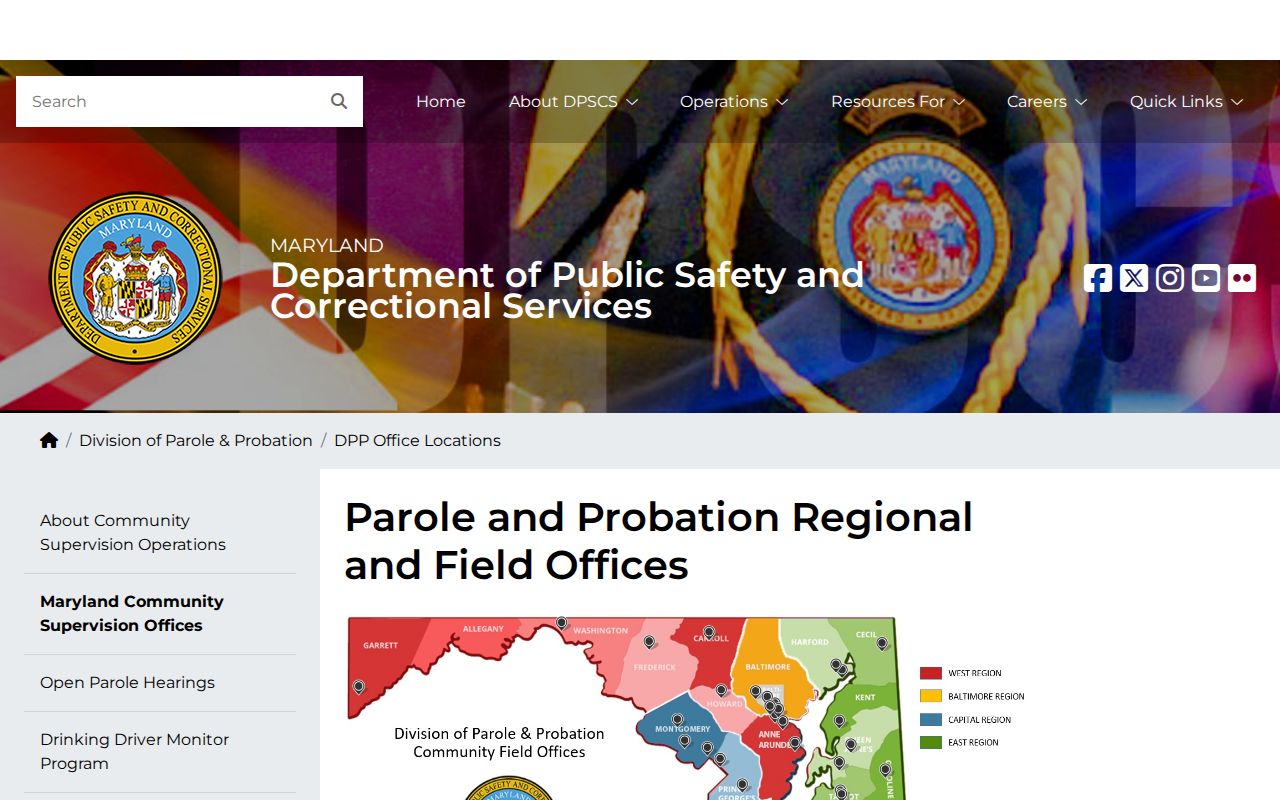
The captured directory view documents the agency route; it is not a public person-search result or proof that any named individual is supervised.
The Division of Parole and Probation central number is 410-585-3500. Parole-decision questions may instead belong with the Maryland Parole Commission at 410-585-3200 or 877-241-5428. Give the exact case or DPSCS identifier when one is known. That helps prevent a false match between people with similar names.
Note: Office staff may restrict detailed conditions and personal locations even when they can confirm the correct supervising unit.
Garrett Supervision Status Changes
Conditions are the enforceable rules attached to a release or sentence. The exact set comes from the order and supervising agency, not from a general web page. A violation claim can lead to an agency action, hearing, warrant, retake process, or court review. It does not by itself prove that supervision was revoked or that the person returned to custody.
An absconder is a person whom the responsible agency has formally classified as having lost contact or failed to comply. It is not a label for someone whose address is unknown to a web user. No Garrett-specific public parole absconder list was identified. The Sheriff’s outstanding-warrant cards are selective, not a full warrant database. Confirm a warrant or violation through the court, Sheriff, Commission, or supervising office.
- Parole
- Conditional community release during a sentence after a parole decision.
- Probation
- Court-ordered supervision that may follow custody or a suspended sentence.
- Mandatory supervision
- Conditional release based on the sentence less applicable diminution credits.
- Absconder
- An official supervision status tied to alleged loss of contact or noncompliance.
- Discharge
- The formal end of the agency’s supervision authority when lawfully entered.
Maryland VINE may report a supervising-agent change and a violation-hearing result. Such a notice is a reported event from a named source. It should be read with the court or agency record.
Garrett VINE Supervision Alerts
Maryland VINE spans detention centers, courts, parole, and probation. Its documented event types include release, transfer, a change in supervising agent, and violation-hearing results. Search the matching person or case and check which agency supplied the record. A detention-center release is not the same event as a parole status change.
Registration may need to be renewed when a matter moves from District Court to Circuit Court, from local detention to the Division of Correction, or into parole or probation. Phone registration uses a four-digit PIN. VINE registration is also distinct from the separate written DOC Victim Services program. A VINE alert helps track a change but does not replace direct confirmation by the Oakland office or the sentencing court.
Garrett Release Reentry Referrals
The Garrett County Detention Center reports that a reentry coordinator assesses needs and makes referrals during custody and after release. The Sheriff also documents work with the Garrett County Health Department and continuity referrals linked to substance-use services. These are navigation and continuity-of-care resources. They are not parole decisions, probation orders, or proof of discharge.
A person can receive a referral without being under state supervision. Conversely, a person on parole or probation may need help that is outside the legal role of the supervising agent. Keeping those functions separate makes questions clearer: ask DPP about official supervision, ask the court about its order, and ask the detention program about a documented referral or continuity plan.
The official Detention Center Programs and Services page supplies the local program context. Availability and eligibility can change, so the coordinator or provider should confirm current access.
Garrett Supervision Discharge Records
Supervision ends through an official event, not merely because a web result disappears. For probation, review the Garrett sentencing docket for the term, any modification, violation, early discharge, or completion entry. For parole or mandatory supervision, ask DPP or the Maryland Parole Commission for the public record that states the end status and effective date.
Maryland’s Public Information Act allows requests for existing agency records, but access is not unlimited. Protected personal data, investigatory material, safety-sensitive facts, and sealed or expunged records may be withheld or redacted. Under General Provisions § 4-203, a custodian generally grants or denies promptly and no later than 30 days. If production will take more than ten working days, the required timing and fee-range notice applies.
A discharge means the formal end of that supervision authority. It does not erase the criminal case, prove that every obligation has ended, or resolve another jurisdiction’s hold. Read the discharge with the sentencing case and any later order.
Garrett Parole Decision Records
The Maryland Parole Commission has exclusive authority to authorize Maryland parole. Its open-hearing material can identify a scheduled hearing date, time, location or facility location, name, and DOC identifier. That calendar is not a list of all hearings and is not a results database. A calendar entry proves only that an open hearing was scheduled when the source was checked.
Official outcomes can include refusal, a rehearing at a later time, or approval for parole release. Approval may carry steps that must be met before release, so it should not be converted into a same-day release claim. No official public statewide name-based individual decision search was found. Contact the Commission and ask what part of a Garrett-origin decision is public.
Parole eligibility also differs from release. Correctional Services § 7-301 applies distinct rules to ordinary, violent, life, mixed, and specified repeat-offense sentences. The Commission’s decision and the agency’s sentence computation must be read together. After release, the Oakland DPP office is the local supervision route, while the Commission remains the parole-decision source.
A Commission approval may include prerelease requirements that must be completed before the person leaves custody. A refusal or rehearing setting keeps the case in the parole process without authorizing release. For accurate Garrett County supervision records, preserve the decision date, effective date, and the office named in the later release or supervision record. This prevents a hearing schedule from being mistaken for an active parole term or discharge.
Always confirm the final status with the office that owns it.