
Garrett Projected and Actual Release
A projected date is an agency’s current calculation of when custody may end or change under the sentence and credits then recorded. It is not the same as the actual release date, which records the completed event. The projection can move. The actual record should state when the person left that custody and whether the event was community release or transfer.
Pretrial custody works differently. No sentence ledger exists before sentencing. A person held at Garrett County Detention Center may leave after a bond or recognizance decision, dismissal, court order, or other authority, but another hold can prevent release. The District Court Commissioner’s coverage does not establish a fixed jail processing time.
A raw sentence length should never be turned into a promised day. Jail credit, concurrent or consecutive terms, offense dates, statutory credits, and later agency actions all affect the computation.
Find Garrett Projected Release Dates
First identify who holds the person. A short Garrett jail sentence and a sentence committed to Maryland’s Commissioner of Correction use different credit frameworks. The DPSCS Incarcerated Individual Locator can show a current placement for some covered people, but it does not publish a projected or historical release-date field.
- Use the Garrett sentencing case to identify the sentence, date, court, and whether custody is local or committed to the Commissioner.
- For a local sentence, call the Detention Center at 301-334-5055 and ask for the certified computation or public release-date information.
- For a state sentence, use the DPSCS locator only to confirm current covered custody, then request the institutional time computation from DPSCS.
- Ask for the projected mandatory-supervision date, maximum expiration date, diminution-credit ledger, and recalculation history where access is allowed.
- Check the sentencing docket for amendments, later sentences, violation actions, or court orders that change the underlying calculation.
The Garrett County release-record search connects those court, county, and state sources. Use full name plus a date of birth, case number, or DPSCS number to avoid a false match.
The official DPSCS locator page states its current-custody scope.
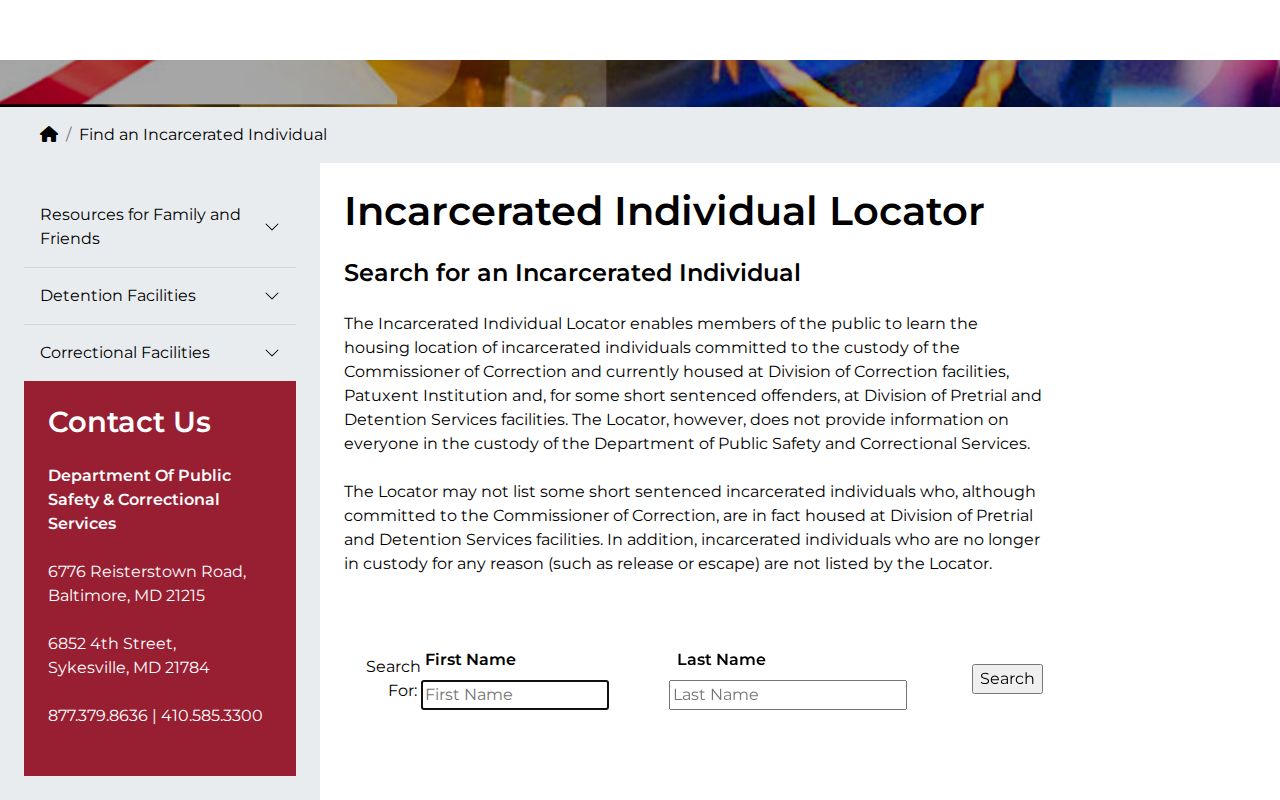
The screenshot documents why the public locator cannot serve as a projected-release result or released-person archive.
Maryland State Release Credits
For a state sentence, Correctional Services § 3-704 generally provides an advance good-conduct deduction of ten days per calendar month, prorated. The rate is five days per month when the term includes a concurrent or consecutive crime of violence under the named statute or specified controlled-substance offenses. Excluded periods, such as escape or noncustody time, do not accrue credits under the stated rule.
Other state provisions may add five days per month for satisfactory work and five for progress in qualifying education, treatment, vocational, life-skills, cognitive, or antiviolence programs. Special-project credit can also apply within statutory limits. Section 3-708 imposes aggregate monthly caps for the classes it describes.
These are possible ledger components, not a public calculator. Awards, overlap, caps, forfeiture, restoration, offense date, and sentence structure must be read from the official computation. A third-party countdown cannot reproduce the agency ledger.
The state credit statute is the source for the good-conduct framework.
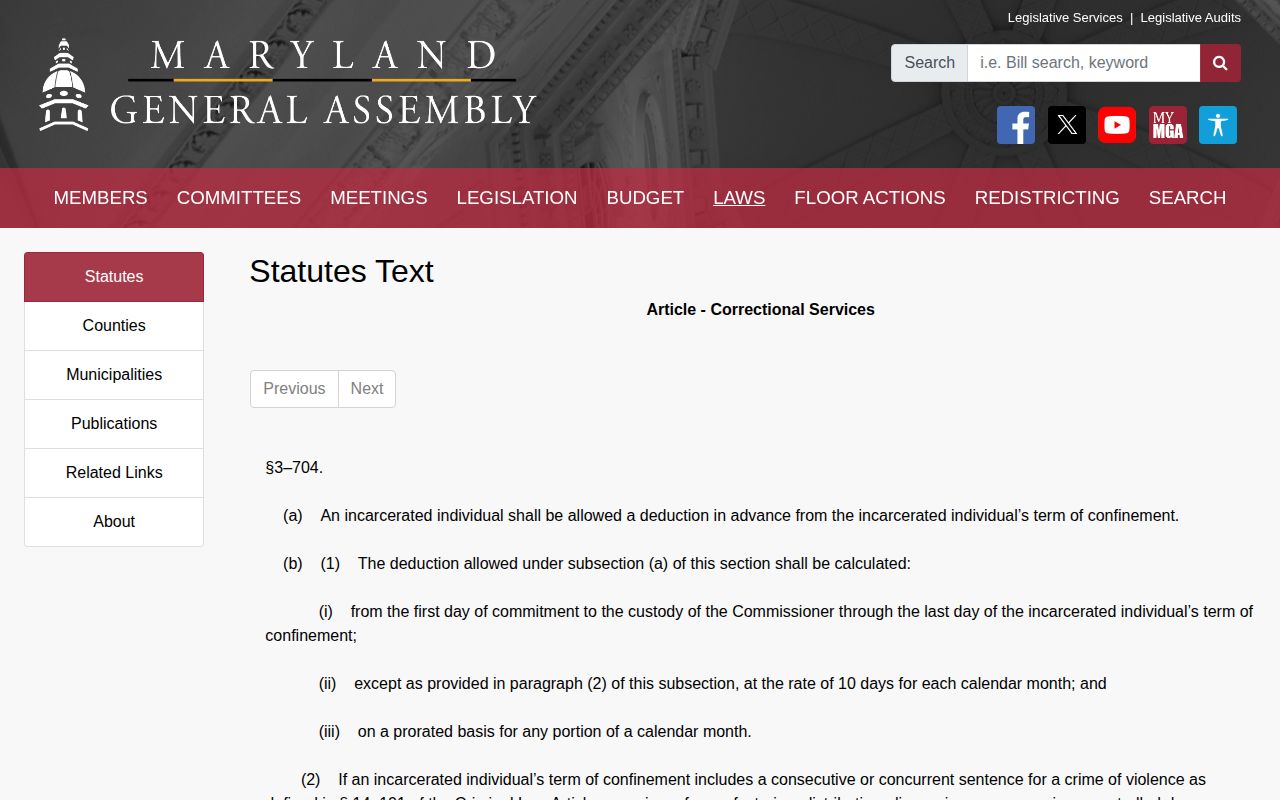
The captured law page supports the statutory rates, while the person’s own ledger determines how those rules were applied.
Garrett Jail Release Credits
Maryland separates local detention credits in Correctional Services Title 11 from the state-prison rules in Title 3. Section 11-503 addresses presentence local confinement. Section 11-504 generally provides a postsentence initial deduction of ten days per month, reduced to five when the term includes the designated violent or drug offenses.
Sections 11-505 and 11-506 authorize limited added education, task, or special-project credits. Section 11-507 permits revocation for a disciplinary violation with due process. A short sentence still housed in Garrett County is therefore not computed solely under the state-prison credit provisions.
The local detention credit statute is the source for this distinct rule.
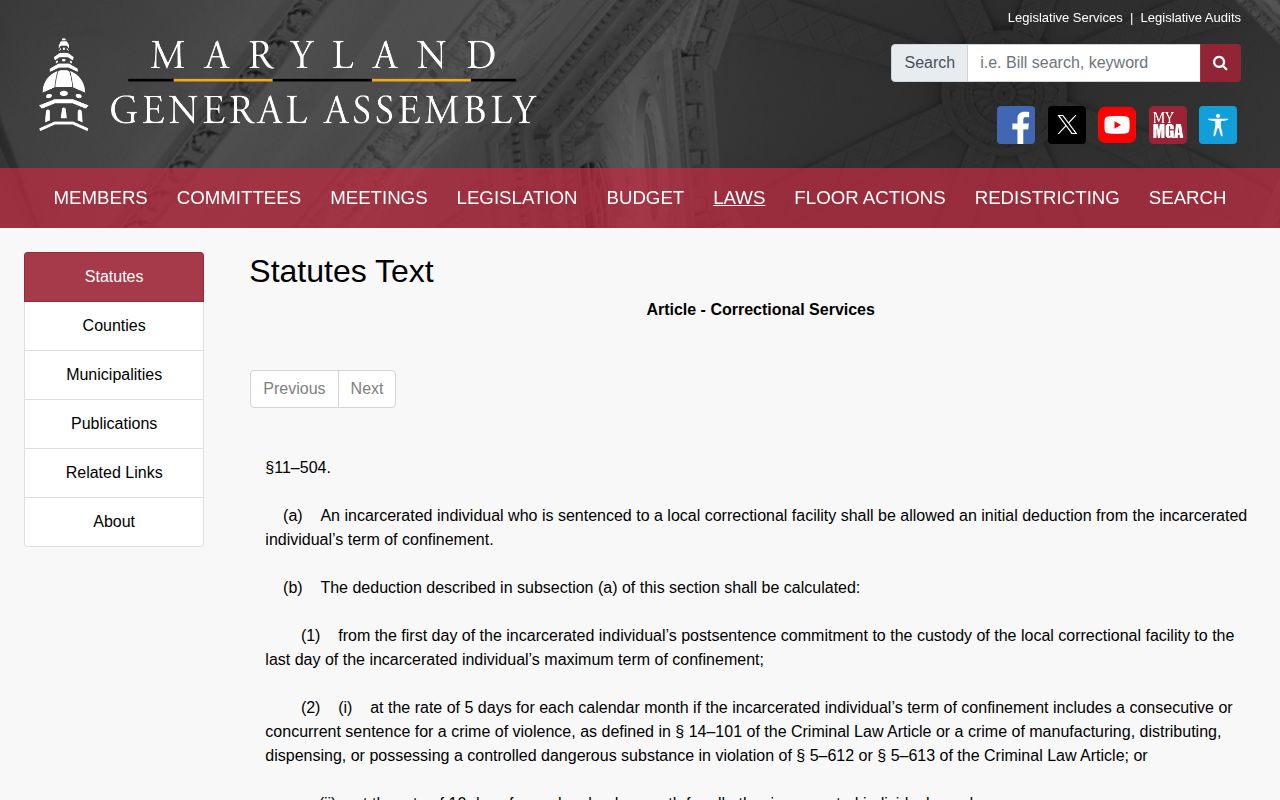
The image reinforces the local-state split that makes the actual custodian’s certified ledger essential.
Garrett Parole Eligibility Dates
Maryland has no general rule that every prisoner must serve about 85 percent of a sentence. That shortcut must not be imported into a Garrett projected-release estimate. Under Correctional Services § 7-301, an ordinary qualifying sentence of six months or more is generally parole-eligible after one-quarter of the aggregate term.
Covered violent-crime sentences committed on or after October 1, 1994 generally use the greater of one-half of aggregate violent terms or one-quarter of the total aggregate term. Life and specified repeat drug sentences follow other rules. Eligibility is not approval. The Commission can refuse parole, set a rehearing, or approve release with prerequisites.
Parole is conditional community release while the sentence continues under supervision. It should not be confused with maximum expiration or a projected mandatory-supervision date.
Why Garrett Release Dates Move
A valid projection can change after it is reported. The agency should identify the source date and later recalculation. Each listed factor affects either the sentence base, the credit ledger, release authority, or the ability to leave custody.
| Factor | Possible effect |
|---|---|
| Jail credit | Adds verified time already served to the computation |
| Concurrent or consecutive sentence | Changes how multiple terms combine |
| Credit award or restoration | Can move a projected date earlier within the law |
| Credit forfeiture | Can move the date later after the required process |
| Court amendment | Changes the controlling sentence or custody authority |
| Parole action | May approve, refuse, condition, or revisit conditional release |
| Detainer or hold | May cause transfer or prevent community release |
A detainer is another agency’s request or authority affecting custody. Even when one sentence reaches its expected date, a valid hold can send the person to another custodian instead of home.
Confirm Garrett Actual Release
Ask the custodian for the latest certified date and its “as of” date. Then check for any new case, warrant, violation, parole action, or other jurisdiction’s hold. For Garrett jail custody, call the detention center. For state custody, use DPSCS records and the institution or authorized case channel.
A Garrett VINELink inmate search can register an alert for a reported release or transfer. VINE does not guarantee the exact event time, and its registration is separate from the DOC written-notification program. Confirm the event with the reporting agency.
- Projected date
- The agency’s current conditional computation.
- Maximum expiration
- The sentence endpoint shown by the official calculation, subject to lawful changes.
- Diminution credit
- A statutory sentence deduction recorded and administered by the custodian.
- Actual release
- The completed custody event recorded by the releasing agency.
Note: A no-result in the DPSCS public locator is not release proof because the tool excludes people no longer in custody for any reason.
Request Garrett Release Calculations
A state record request should identify the Division of Correction record and ask for the sentence computation, maximum expiration, projected mandatory-supervision release date, diminution-credit ledger, actual release date and type, release certificate, and recalculation history. Access to another person’s detailed record can be restricted. A person asking for their own record may need identity proof or authorization.
For a local Garrett sentence, direct the request to the detention center and Sheriff. Give the sentencing case, booking period, and identifiers. Ask which local-credit provisions were applied and whether the person was later committed or transferred to the Commissioner. That custody change determines which calculation context controls.
The Maryland Public Information Act permits access to existing public records, subject to exemptions and redaction. It does not require an agency to calculate a hypothetical date. Ask for the certified existing ledger rather than giving raw sentence numbers and requesting a new estimate.
Garrett Mandatory Supervision Release
Mandatory supervision is a conditional release tied to the sentence less applicable diminution credits. It is not the same as parole, even though the person remains under community supervision. Correctional Services § 3-711 supplies the state framework, while other provisions govern how credits are earned, lost, restored, and capped.
Correctional Services § 7-501 affects qualifying violent-crime mandatory-supervision release by preventing release before the applicable parole-eligibility point. It also requires conditional release when the qualifying term less credits has been served. The person generally remains supervised through maximum expiration unless lawfully discharged earlier.
A projected mandatory-supervision date can move with the credit ledger and sentence. Ask DPSCS for the label it actually uses, the calculation date, and the maximum expiration date. Do not describe the public locator as displaying this information.
Garrett Court Sentence Changes
Maryland Judiciary Case Search can show sentence entries, suspended terms, later modifications, violation proceedings, and docket activity. Search both Garrett District and Circuit Courts when the path is unclear. The court record explains legal changes but does not reproduce the custodian’s day-by-day credit ledger.
A concurrent sentence runs alongside another term to the extent ordered. A consecutive sentence follows another term. New cases and amended orders can change the aggregate calculation. Presentence jail credit also depends on the official award and cannot safely be guessed from the arrest date alone.
If a case summary is incomplete, request the full file from the clerk. Some public records may be available only at the courthouse, and sealed or expunged material may be unavailable. Pair any court order with the new computation issued by the actual custodian.
Garrett Circuit Court records are handled by the clerk at 203 South Fourth Street in Oakland, while the District Court is at 205 South Third Street. The two courts serve different parts of the criminal process. Use the court that created the record, and provide the case number whenever possible.
Timing matters after a modification. The docket can show that a judge signed an order, but DPSCS or the county jail may need time to receive, audit, and apply it. Ask the custodian when the revised ledger became effective. The projected release date should be reported from that revised computation, not from the order alone.
A parole approval presents another timing gap. Approval may include prerelease conditions and does not always authorize an immediate exit. Confirm that the requirements were met and that the releasing agency recorded the actual event.
Use the same caution with a future VINE date. It can help track an anticipated event, but the custodian’s current certified computation remains the controlling source for Garrett County projected release.