
Garrett 72 Hour Release Source
No separate official Garrett County 72-hour release URL was found. The Sheriff Arrest Log is the starting point. It keeps recent cards and month archives, including entries later marked RELEASED. It does not offer a release-time filter or promise that its updates form a rolling three-day window.
A 72-hour review is still useful as a catch-up method. It allows time to inspect more entries, compare archive pages, and notice status changes that were not visible during a brief same-day check. Its value is breadth, not timestamp precision. If the interval crosses the end of a month, inspect both monthly archive pages.
Check Garrett Three-Day Jail Releases
Set an exact beginning and end for the three-day interval. Then distinguish the booking date from the event being researched. The online log can identify candidates, while the detention center or release record confirms whether each person left during that span.
- Open the current Sheriff Arrest Log and identify the month or months that contain relevant arrests.
- Review every likely card and open its detail page. Compare name, date, photograph, and broad status.
- List entries marked
RELEASEDas candidates only. Do not assign the arrest date as the release date. - Call the Detention Center at 301-334-5055 and ask whether a public confirmation can be given for the stated interval.
- Request any existing three-day release log when exact times, release types, or receiving agencies are needed.
The Garrett 24-hour release check is better for a narrow same-day question. A named-person search may also require the court docket, Maryland VINE, or the system that received a transfer.
Garrett 72 Hour Record Fields
The public archive does not become a fuller release record when several days are reviewed. It offers the same limited fields on each page. Missing items must be obtained from the agency that processed the custody change.
| Field | Availability in the Sheriff log |
|---|---|
| Name | Displayed |
| Arrest or booking date | Displayed as the visible date |
| Broad status | RELEASED, PENDING, or SENTENCED |
| Booking image | Displayed on the detail record |
| Actual release date and time | Not displayed separately |
| Release type, authority, destination | Not displayed |
Ask for booking and release identifiers, release date and time, legal authority, and receiving agency in a records request. These request terms describe the information sought. They do not assert that Garrett maintains one public form with every field.
Garrett Weekend Release Checks
The District Court Commissioner station has staffed and on-call coverage described in the Judiciary directory. That means a judicial release decision can occur outside ordinary clerk-office hours. It does not establish the jail’s physical release-processing time, public exit, or weekend pickup process.
Status publication can also lag the underlying event because the Sheriff gives no update cadence. A Friday booking may remain pending online after a release decision, or an older booking may change to released during the weekend. Check the log again after the interval and record when each dynamic check was made.
No official release desk location, weekend procedure, family waiting area, or property-return schedule was published. For a specific event, call the detention center and confirm the release exit, pickup instructions, and whether another agency will receive custody.
Note: A court order explains legal authority, while the jail record supplies the actual door time and transfer status.
Request Garrett Three-Day Records
Garrett County’s public-information form is the documented request route. Give the precise three-day range and ask for an electronic copy of an existing release log. State that a transfer or receiving agency should be identified when the record contains it. The Maryland Public Information Act does not compel creation of a list the agency does not keep.
For Sheriff material, copy or address the Sheriff at 311 East Alder Street, Oakland, MD 21550, 301-334-1911, and ask the county contact to route the request if needed. Maryland General Provisions § 4-203 sets the response framework. Section 4-206 permits reasonable actual-cost fees and gives the first two hours of search and preparation without charge. Ask for an estimate before costs are incurred.
Other systems answer different questions. Maryland VINE can report custody events from participating sources. The DPSCS locator helps with covered people still in state custody, but expressly excludes people no longer in custody. BOP and ICE have separate federal scope. None should be used as a substitute for Garrett’s own three-day release record.
Garrett Monthly Release Archive
The official month archive is Garrett County’s distinctive strength. At research time, its navigation exposed months from August 2024 through July 2026, and older entries could remain marked released. This observed availability shows that a three-day review need not depend only on current cards.
The official monthly archive illustrates the retained mix of status entries.
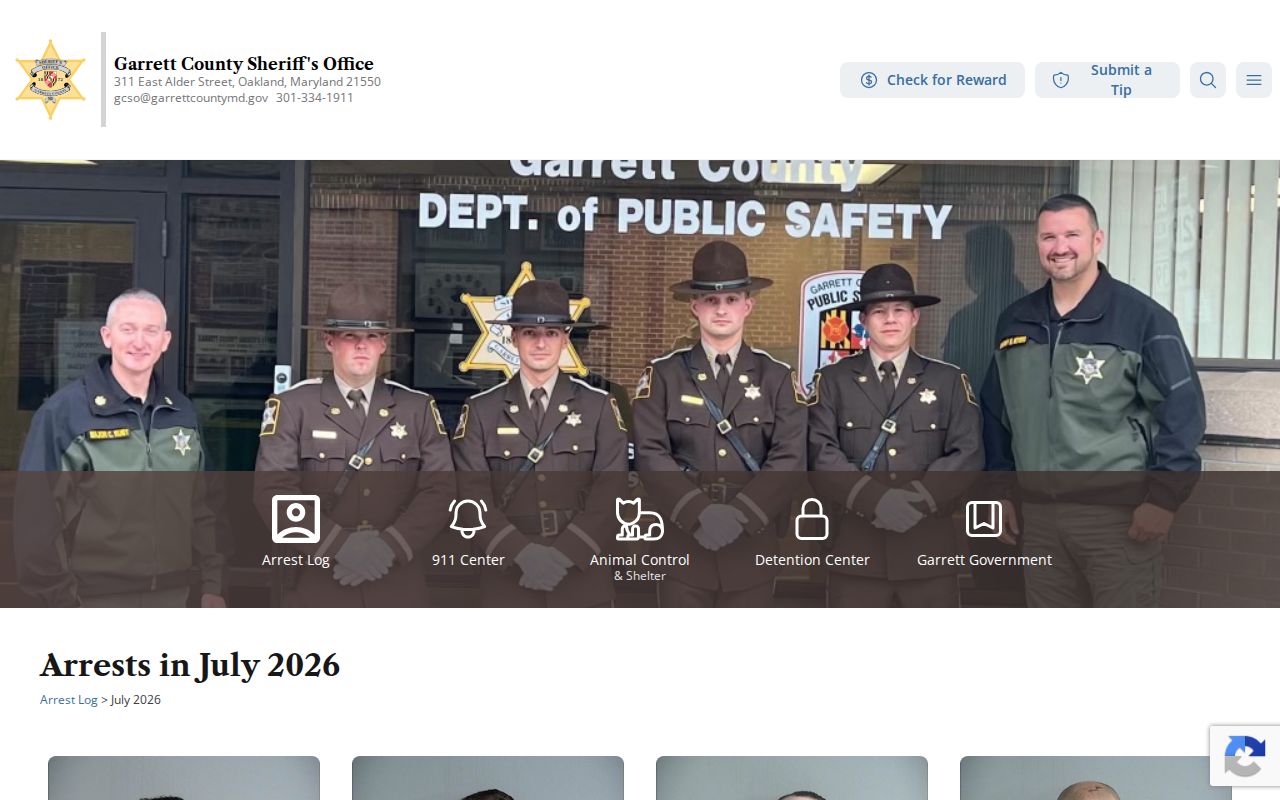
The image shows why the archive can locate past released entries, but it also reinforces that the month groups arrests rather than releases by hour.
No formal web-retention policy was published. An older government record may exist after a web card disappears, and the earliest month can move. Use a PIA request for material outside the displayed archive instead of treating the web range as the legal retention period.
Garrett Release Destination Check
A three-day list should not collapse every departure into community release. Garrett County Detention Center houses pretrial detainees, local sentenced people, and people awaiting transfer. A released card might pair with bond, pretrial conditions, Home Detention, time served, or another legal basis, while a building departure may also be a transfer.
- Community release
- Confirm through the release sheet and controlling court order.
- Local supervision
- Check Pre-Trial Services or Home Detention and the court docket.
- State transfer
- Use DPSCS current-custody sources and the sentencing case.
- Federal transfer
- Use the relevant BOP, ICE, USMS, and federal court route.
A Sheriff status has value within its scope. The receiving record completes the path when Garrett no longer has custody.
Match Garrett Three-Day Records
A wider window increases the chance of similar names and unrelated arrests. Match at least two identifiers when possible. The public detail provides name, date, status, and photograph. A case number, date of birth, booking identifier, or known court case adds a safer comparison. Record name variants and suffixes exactly as official sources show them.
Absence remains weak evidence. It may reflect spelling, a site delay, transfer, sealed or expunged material, a record outside the visible archive, or a source that does not cover the custody. A positive record also has limited meaning. The Sheriff status belongs to its Arrest Log, while a court entry belongs to the judicial case and a VINE alert belongs to the reporting source.
For an interval that crosses a month, preserve both archive URLs and the check date. Do not merge multiple people or infer that a photo alone proves the match. The release sheet should be the final source for the actual event.
Scope Garrett 72 Hour Requests
A narrow request is easier to route and less likely to seek a newly created report. State the beginning and end in local time. Ask for any existing log or records of releases processed by Garrett County Detention Center during that period. Specify actual release time, release type or authority, and transfer destination where those fields exist.
Request electronic records and permit lawful redaction of protected material while asking for the separable public part. Juvenile, safety-sensitive, investigatory, sealed, and expunged information can be restricted. The fact that an adult booking card appears online does not mean every operational field is public.
If the office says no three-day list exists, ask whether individual release sheets or a daily custody-status log can be searched for the interval. The PIA supplies access to existing records, not a duty to calculate or compile a custom roster. Keep the response, fee estimate, and production date with the records because dynamic web statuses may later change.
When a release sheet names a receiving agency, continue with that agency’s locator or records channel. If it shows bond, recognizance, or a local supervision program, review the controlling Garrett court order. This follow-through matters because a three-day count can otherwise combine community releases with transfers and create a misleading result.
Preserve the stated interval, source date, and response date. Those details let a later reader tell whether a status change happened within the requested three days or appeared only after the agency updated its public page.