
No Garrett BOP Institution
The official facility directories reviewed did not identify a Bureau of Prisons institution at a Garrett County address. A federal prosecution connected to Oakland or a person first encountered in Garrett County does not create a local federal prison. Federal defendants can be held under contract, transported by the U.S. Marshals Service, and assigned by BOP to an institution in another part of the country.
This location boundary prevents a common mistake. The Garrett County Sheriff Arrest Log records the county custody event. It cannot establish admission to or release from federal prison. Likewise, a departure from Garrett County Detention Center may be a handoff rather than community release. Follow the receiving agency, federal register number, and federal court case once the record shows federal custody.
BOP Federal Release Search
The BOP Inmate Locator generally provides online records for federal inmates released from 1982 onward as well as current prisoners. Search by BOP register number when available. The tool also accepts FBI, DCDC, or INS numbers, and it permits a name search with demographic narrowing. Number searches are valuable because common names and name variants can create false matches.
- Choose the identifier search and enter the full federal number when one is known.
- Otherwise use the exact legal name and add age, race, or sex only to narrow a real match.
- Compare register number, age, and other returned fields with the federal court record.
- Read location and release date in BOP’s scope. Save the check date because a projection can change.
- If the person is not in BOP custody, review the federal docket and determine whether USMS, state, local, or ICE custody applies.
A result may show register number, age, race, sex, location, and a release date. A past date supports a former BOP release within the record’s scope. A future date is projected. UNKNOWN means the confinement term is not determined. First Step Act and other recalculations are among the reasons BOP advises users to recheck dates.
The official BOP search page and following image identify the federal locator, not a Garrett County facility.
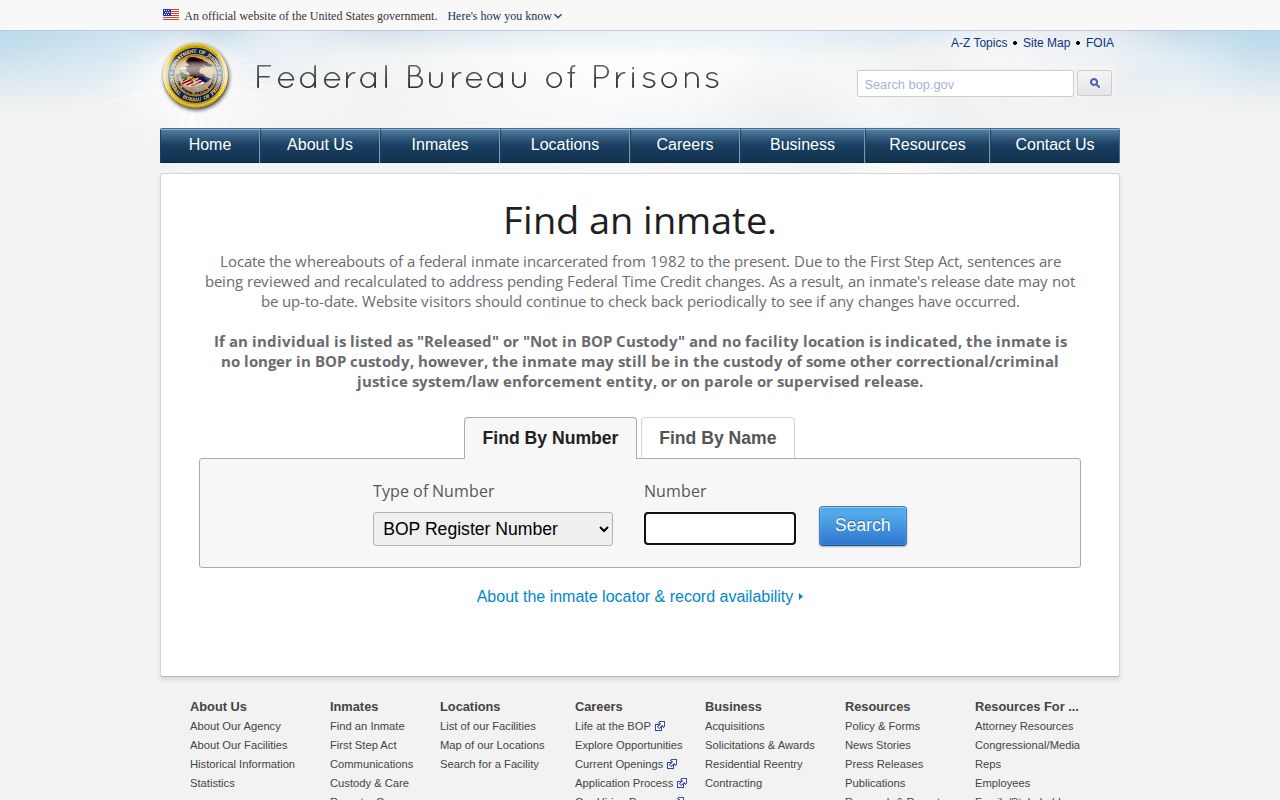
The image reinforces that federal current and former records belong in BOP’s national system.
Read BOP Release Status
BOP explains that Released or Not in BOP Custody, with no facility, means the person is not currently in Bureau custody. That statement is agency specific. It does not exclude federal supervised release, state or local incarceration, civil immigration detention, or another form of custody. A person can be outside BOP and still have court-ordered obligations.
The federal court docket supplies the judicial context. It can show the sentence, later orders, and a term of supervised release. Supervised release is court-ordered community monitoring after federal imprisonment; it is not BOP confinement. A probation office may supervise it, while the sentencing court retains authority. A locator result and a docket should therefore be read together.
| BOP display | Safe meaning | What to check next |
|---|---|---|
| Named institution | BOP reports current location | Institution and federal docket |
| Future release date | Projected BOP date | Recheck for recalculation or orders |
| Released / no facility | Not currently in BOP custody | Supervised release and other custodians |
| Unknown | Term is not determined in the locator | Court, counsel, and BOP records |
Note: “Not in BOP custody” is not the same claim as “free from every federal, state, local, or civil authority.”
BOP Federal Release Records
Use the register number and exact federal case whenever requesting a record. A focused request can identify the actual release date, release institution, custody-status history, and destination or transfer information that is publicly disclosable. Privacy and law-enforcement exemptions can limit a third party’s access. A person seeking their own record may need identity verification.
For records before 1982, BOP directs researchers toward National Archives channels rather than promising coverage in the online locator. For a modern case, start with the locator and BOP’s official records or FOIA process. The federal court clerk controls judicial records, while BOP controls its correctional file. Do not ask the Garrett Sheriff to supply a federal prison discharge record it did not create.
- Register number
- The BOP identifier that helps distinguish people with similar names.
- Projected date
- A date that may change before actual release.
- Supervised release
- Federal court monitoring in the community after imprisonment.
- Transfer
- Movement to another custodian, not necessarily release to the community.
USMS Pretrial Custody Difference
The U.S. Marshals Service manages federal pretrial prisoners and transports people until commitment, release, or return to another custodian. Its Prisoner Tracking System is not a public name locator. A federal defendant may therefore be in USMS custody without a useful BOP result, especially before commitment to a federal sentence.
Use the federal court docket, counsel, and court clerk to follow a pretrial case. The USMS Prisoner Operations page explains the agency role. A focused FOIA request may seek an existing record, though privacy and law-enforcement exemptions can restrict disclosure. Do not treat BOP silence as proof of release during this pretrial phase.
A practical custody flow is: federal arrest → USMS pretrial custody → court decision → release, commitment to BOP, or transfer → possible supervised release after imprisonment. Each agency owns a different part of the record.
BOP Release and ICE Custody
A person can leave BOP custody and enter immigration detention. If BOP shows release but the case or correctional record suggests an immigration hold, search the ICE Online Detainee Locator. It accepts a nine-digit A-number and country of birth or biographical information. ICE excludes people under 18 from public results and describes limited coverage for people recently released from its custody.
Garrett County’s former 287(g) arrangement ended in February 2026. That local history neither establishes nor rules out a federal immigration transfer after BOP custody. Use ICE’s own system and Baltimore Field Office route. A BOP release date shows the federal prison event, while the receiving record shows whether another sovereign took custody.
Note: A detainer can affect destination and timing, but only the completed records establish whether a transfer actually occurred.
BOP Federal Release Dates
BOP cautions that a future release date can change. Sentence recalculation, earned-time or good-conduct treatment, court orders, disciplinary action, and other legal events can affect the projection. A locator date should be reported as shown and paired with the access date. It should never be turned into a guaranteed pickup time.
The exact institution controls release logistics. Because there is no BOP institution in Garrett County, no local address, gate, schedule, property process, or transportation rule can be supplied for a generic Garrett-connected federal case. Contact the institution shown in the locator and follow its official instructions. Federal court release to supervision is also distinct from the facility’s physical processing.
The Garrett County release-record overview helps when the custody began locally but later moved federal. Once BOP owns the correctional record, federal sources outrank the county archive for release date and institution.
BOP Release Contact Routing
No Garrett County BOP contact card exists because no local institution was identified. Use the institution displayed in the BOP locator for a current prisoner. For a former prisoner, use BOP’s official locator information and records channels, and use the federal court clerk for the judicial case. Avoid sending a nationwide release question to the Garrett County Detention Center.
National inmate and former-inmate locator
Use the institution shown in the official result
Current and former federal records from 1982 forward
www.bop.gov/inmateloc/
For identity control, preserve the register number, full legal name, and case number. If a result cannot be matched, return to the court docket rather than guessing from age or name alone. The court, BOP, USMS, and ICE channels should be kept separate in notes so the final conclusion identifies which agency supplied each fact.
Federal Release History Limits
The BOP online record’s 1982 boundary is more durable than a county web archive, but it is still a defined scope. Earlier federal confinement belongs in archival research. Modern BOP history can show a past release date, yet the locator does not replace the full correctional file or federal docket. Use the tool for a first-party status, then obtain the record needed for the precise question.
Garrett’s own detention center history, state prison placement system, and federal BOP system describe different institutions. Keeping those histories separate prevents a local arrest card from being mistaken for federal discharge evidence and prevents nearby or distant prisons from being labeled as Garrett County facilities.
Public Record Search
Sponsored Results